5D Parallelism #1: What needs to be stored in the GPU during LLM training?
The first post in a series building up to 5D parallelism. Before we split a model across many GPUs, let's figure out what actually fills a single GPU: parameters, gradients, optimizer states, and activations, which usually end up taking the most.
This is the first post in a series building up to 5D parallelism, the set of techniques for training models across multiple GPUs.
We'll start with one GPU. Before we can talk about splitting a model across many of them, we need to know what fills up one of them in the first place.
So, what needs to be stored in the GPU during training? Four things:
- Parameters
- Gradients
- Optimizer states
- Activations (you need the input to each layer to compute the gradient of the loss with respect to it)
Let's try to calculate how much memory each one takes.
Counting the parameters
We'll assume FP32 for now, so every scalar is 4 bytes. If the model has P parameters, the weights take 4P bytes. So the whole game is finding P.
Notation: v is vocab size, h is embedding dimension, L is the number of transformer blocks.
A) Input block
| Component | Parameters |
|---|---|
| Token embeddings | v · h |
| Positional embeddings | s · h |
B) Each transformer block
| Component | Parameters |
|---|---|
| LayerNorm 1 | 2h (scale and shift per index) |
| Multi-head attention | 4h² (Wq, Wk, Wv, Wo) + 4h (biases) |
| LayerNorm 2 | 2h |
| Feed-forward network | 2 · 4h² + 5h (biases) |
The FFN goes up h -> 4h and back down 4h -> h, which is where the 2 · 4h² comes from. Sum one block:
per block = 12h² + (2h + 4h + 2h + 5h)
          = 12h² + 13h
C) Output block
| Component | Parameters |
|---|---|
| Final LayerNorm | 2h |
| Output projection | v · h (dropped with weight tying) |
We won't count positional embeddings (most modern architectures use RoPE, which injects position inside attention instead of a learned table) or the output projection (weight tying reuses the token embedding matrix). What's left:
P = v·h + L · (12h² + 13h) + 2h
Three things to notice here:
Pdoes not depend on batch size.Pdoes not depend on sequence length.- The
12Lh²term dominates for any real model. Parameter count is basically depth times width squared.
Gradients and optimizer states are just multiples of P, so they don't depend on batch size or sequence length either. Activations are the one thing that does.
Parameters, gradients, and optimizer states
Everything here is just a multiple of P. In FP32:
| Component | Per parameter | Total |
|---|---|---|
| Parameters | 4 bytes | 4P |
| Gradients | 4 bytes | 4P |
| Optimizer states (Adam) | 8 bytes | 8P |
Adam is why the optimizer is the biggest chunk here. It keeps a running mean (momentum) and variance for every parameter, so that's 2 × 4 = 8 bytes each. Add it up and together they cost 16P bytes, four times the weights on their own.
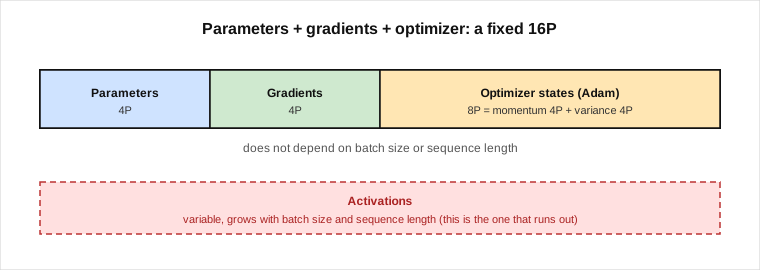
So 16P is fixed. It doesn't change with batch size or sequence length. Activations do, so let's count those next.
What about activations?
An activation is any intermediate value from the forward pass that we keep around because the backward pass needs it. To compute the gradient for a layer, we need the values that flowed through it, so we hold onto them until the backward pass is done.
Unlike those three, activation memory depends on batch size and sequence length. There are three main places activations pile up: the feed-forward networks, the attention blocks, and the layer norms. Let's count the first two carefully.
New notation from here: b is batch size, s is sequence length, n_heads is the number of attention heads. And we switch to FP16 (2 bytes per value), since that's what activations are actually stored in.
Feed-forward network
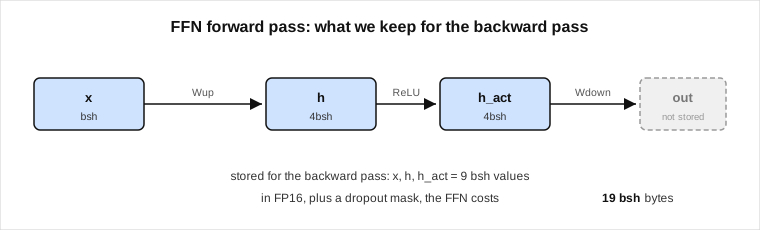
The forward path looks like this:
x ─Wup─▶ h ─ReLU─▶ h_act ─Wdown─▶ out
The tensors we have to keep to compute gradients are x, h and h_act:
| Tensor | Size (elements) |
|---|---|
x | b · s · h |
h | b · s · 4h |
h_act | b · s · 4h |
That's 9 · bsh elements. At 2 bytes each, 18 · bsh. Add the dropout mask (bsh) and the FFN comes to:
FFN activations = 19 · bsh
Attention block
Attention has more moving parts. x gets projected into Q, K, V; we do QKᵀ to get scores, softmax them into weights, multiply by V to get Z, then project through Wo. The tensors we store:
| Tensor | Size (elements) |
|---|---|
x | b · s · h |
Q, K, V | 3 · bsh |
| attention scores | b · n_heads · s · s |
| attention weights | b · n_heads · s · s |
Z | b · s · h |
Count the bsh-shaped tensors (x, Q, K, V, Z = 5bsh), plus the two s²-shaped score and weight tensors, at 2 bytes each, plus the attention and softmax dropout. It works out to:
attention activations = 11 · bsh + 5 · b·n_heads·s²
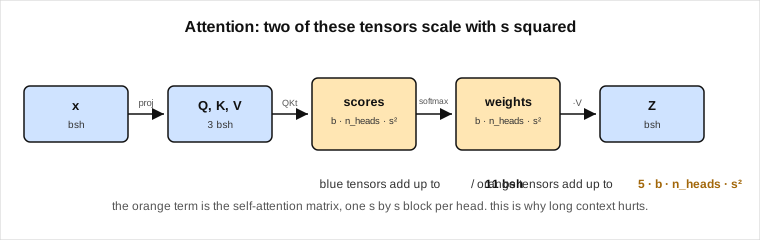
The s² term comes from the attention matrix, one s × s block per head. This is why longer sequences get expensive.
Putting a layer together
Add the FFN, the attention block, and the two layer norms (4bsh at FP16). Factor out sbh:
per layer = sbh · (34 + 5·n_heads·s / h)
And across the whole model of L blocks:
Total activation memory = L · sbh · (34 + 5·n_heads·s / h)
This tells us why activations are the annoying term:
- It's not fixed for a model. Unlike
16P, it changes with the batch size and sequence length you pick. - It scales linearly with batch size. Double the batch, double the activations.
- It scales quadratically with sequence length. That extra
sinside5·n_heads·s/hcomes straight from attention. The FFN grows linearly withs, attention grows withs².
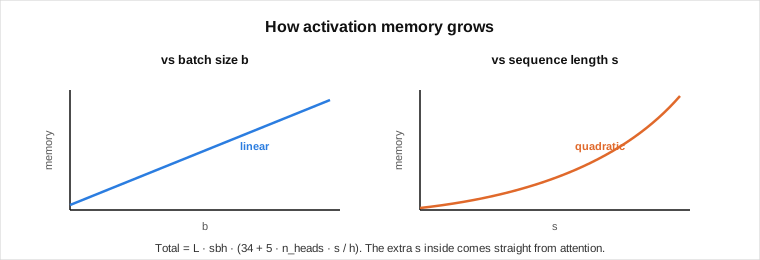
Push the batch size or sequence length far enough and activation memory can match or exceed the parameters, gradients and optimizer states combined. On a single GPU, activations are usually the first thing to run out of memory.
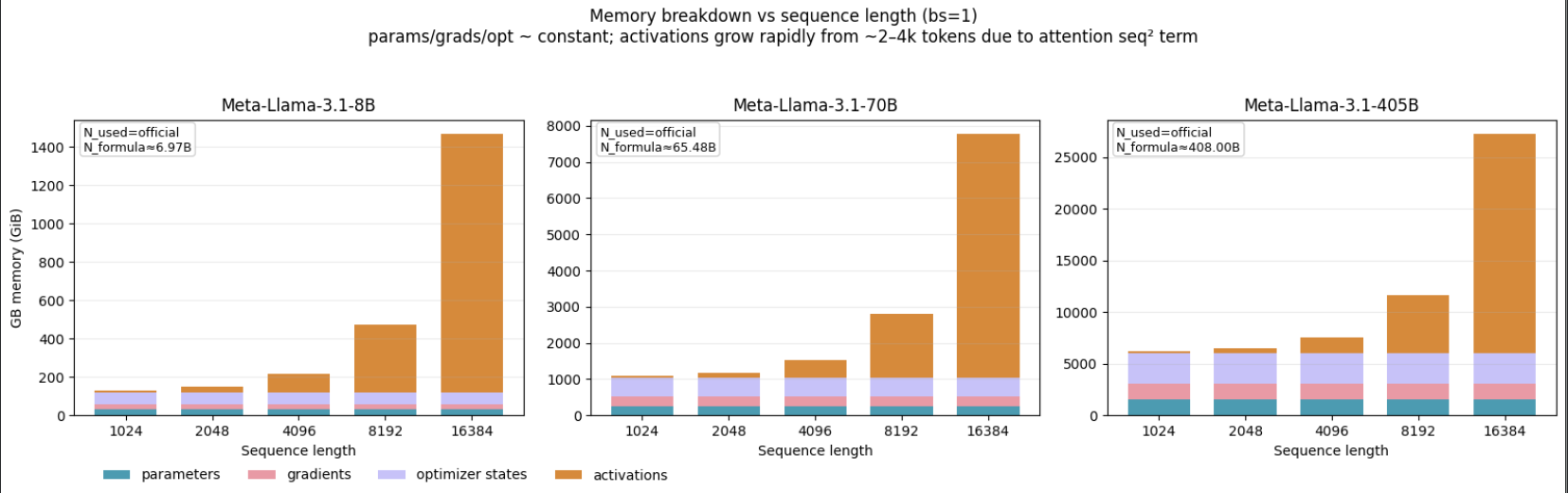
You can see it directly for the Llama-3.1 models above at batch size 1: the parameter, gradient and optimizer bars barely move across sequence lengths, while activations stay small up to a few thousand tokens and then take over, driven by the s² term in attention.
So how do we deal with this?
We now have both halves of the picture:
Params + grads + optimizer = 16P                             (fixed)
Activations                = L · sbh · (34 + 5·n_heads·s/h)  (varies with b and s)
Getting the most out of one GPU means shrinking these two terms:
- Activation recomputation drops most activations in the forward pass and recomputes them in the backward pass, trading compute for the
34 + 5·n_heads·s/hterm. - Gradient accumulation keeps
bsmall per step while still training at a large effective batch size. - Mixed precision lowers the bytes per parameter on the
16Pside.
We'll cover these in the next few posts. After that, we bring in a second GPU and start on parallelism.